Valley Of The Gods
Yggdrasil Gaming's sequel to their popular 2017 original brings players back to an Ancient Egyptian setting with a refreshed mechanical design that departs significantly from its predecessor.

The numbers
RTP
96.2%
Volatility
Medium
Max win
x5800.00
Layout
5×5
Paylines
3125
Bet range
0.1 – 150
Figures as published by Yggdrasil Gaming, founded 2013, Malta. Operators may run a different RTP configuration — check in the game before you play.
About Valley Of The Gods
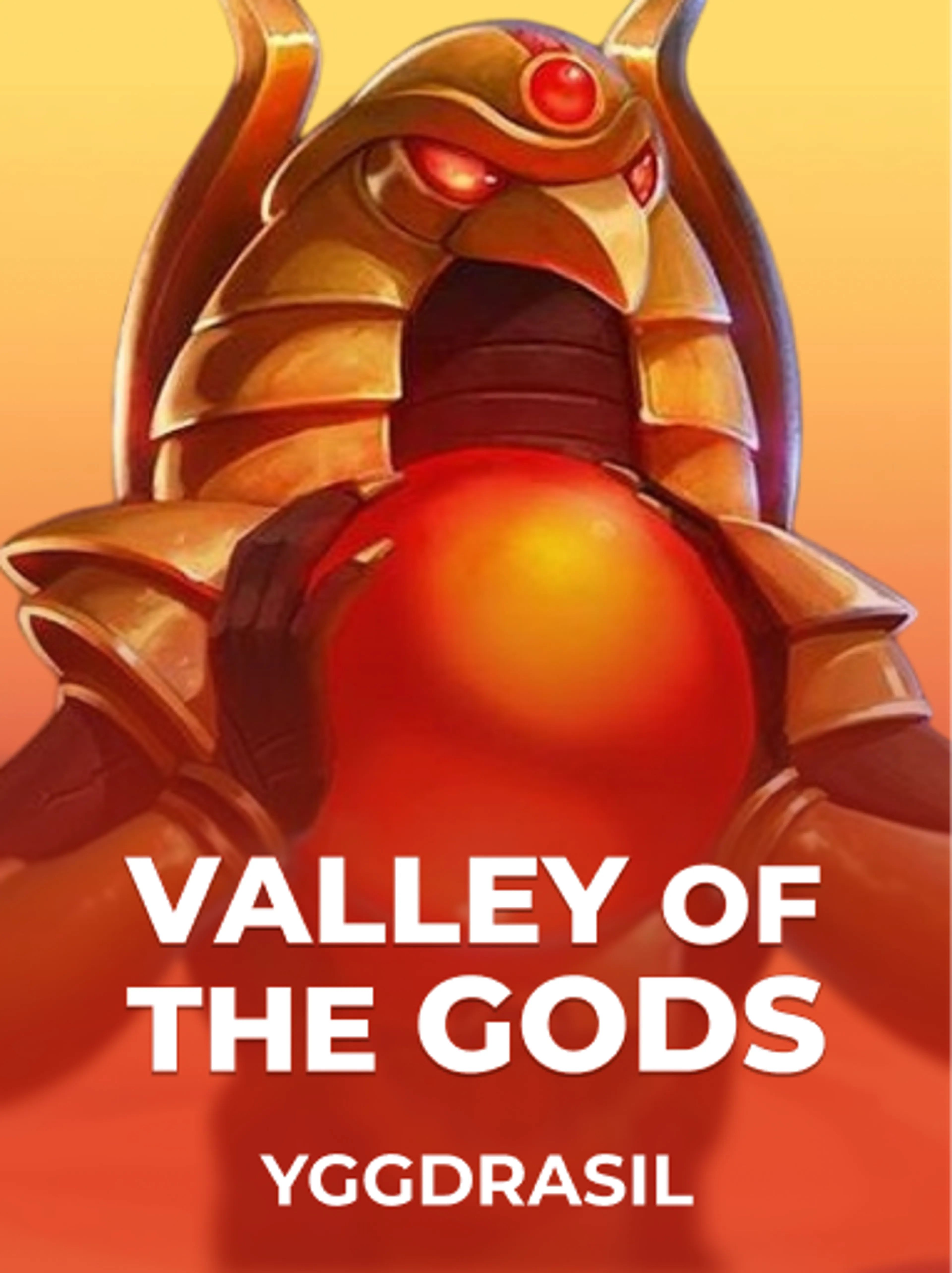
Yggdrasil Gaming's sequel to their popular 2017 original brings players back to an Ancient Egyptian setting with a refreshed mechanical design that departs significantly from its predecessor. The game maintains the desert-themed aesthetic with pyramids and palm trees rendered in heat-hazed backgrounds, supported by an audio landscape that shifts between methodical and energetic passages. The production quality demonstrates Yggdrasil's capability for executing historical and mythological themes at a technical level that extends beyond basic visual design into immersive audio direction.
Game Layout and Structure
Rather than maintaining the original's standard five-reel format, the sequel adopts a six-reel infrastructure with adjustable row counts. The default configuration displays a 1-2-3-4-5-2 symbol arrangement, with scarab-patterned tiles serving as blockers at inactive positions, creating a visual impression resembling a tilted pyramid. This structural choice fundamentally alters how the game functions mechanically compared to its predecessor. The reel area is flanked on the left by three separate modifier meters, providing visual feedback for progression within the bonus mechanics.
Theoretical Performance and Volatility Profile
The game operates at a 96.3% return-to-player percentage, representing a marginal improvement over the original entry. Volatility is positioned at medium-to-high, meaning prize cycles tend toward longer stretches without wins interrupted by more substantial payouts. The hit frequency metric registers at twenty percent across regular play, translating roughly to one winning spin per five attempts under statistical conditions. Players can wager anywhere from 0.25 to 125 currency units per spin, accommodating diverse bankroll approaches. The win mechanism does not employ traditional payline structures; instead, matching symbols require only adjacency beginning from the leftmost reel to form valid combinations. In the default state, this yields two hundred forty win ways, but removing the blocking tiles progressively expands this to as many as twenty thousand, one hundred sixty possible winning routes once the grid reaches its fully open configuration.
Symbol Hierarchy and Base Payouts
Ten regular symbols comprise the pay structure: the nine and ace cards occupy the lower end of the value spectrum, while four god characters—Anubis, Horus, Sobek, and Bastet—command significantly higher payouts. Bastet, depicted as a feline deity, stands as the most rewarding base symbol, awarding twenty times the player's wager when six instances appear in a qualifying combination. The game design omits a standard wild symbol that functions across the reels; instead, wild coverage activates through the bonus mechanics as a distinct feature element.
Progressive Feature Engagement and Respin Architecture
The bonus system operates through layered mechanics that build upon successful spin outcomes. Any win triggers a cascade of events: scarab insects emerge from the winning symbols and progressively destroy adjacent blocker tiles, with the quantity removed corresponding to the number of symbols that formed the winning arrangement. This destruction immediately activates a respin under otherwise unchanged reel conditions. Should the respin produce another winning combination, the process repeats automatically. Once all blocking tiles have been removed from the grid, the game awards an additional life token and unlocks the three distinct modifier meters for active accumulation.
During subsequent wins after grid expansion, different colored scarabs deposit into these meters based on winning symbol colors. Accumulating five red scarabs grants another life token, allowing extended feature play. Five blue scarabs increase the overall win multiplier by a single point. Five golden scarabs trigger placement of a wild reel on a randomly selected position, with that wild reel persisting until either the next winning spin occurs or the respin sequence concludes. The feature continues as long as life tokens remain and new winners appear. When a respin fails to produce a win, one life token is consumed; once lives are exhausted and no additional winners manifest, the respin chain terminates and the grid resets to its original default configuration.
Gameplay Characteristics and Engagement Factor
The design generates a notable compulsion to continue play after witnessing the potential outcomes from a single initial spin. The blocker removal system provides a distinct sense of progression and purpose with each successive win. The mechanics resemble a carefully constructed domino installation where a single initial action can set off an extended chain of subsequent events. Players often observe multiple consecutive respins triggered from the removal of blockers and accumulation of multiplier values or wild reels, creating psychological reinforcement through visible progress toward the expanded win-ways state. The respin feature itself activates relatively frequently at a rate of approximately forty-five point five percent, though individual respin sequences typically resolve with minimal additional wins. This creates a tension between feature frequency and the magnitude of rewards during those features.
Overall Assessment and Audience Suitability
Yggdrasil has successfully developed a sequel that preserves the core appeal of the original while introducing mechanical refinements that enhance gameplay depth. The fundamental design philosophy remains intact, supported by improvements that make the overall experience feel contemporarily fresh without alienating existing fans of the first entry. The wild reel implementation represents the most complex modifier to activate, yet it distinguishes itself as a valuable addition to the feature set. For players transitioning back to the original after extended play on the sequel, the superior mechanical sophistication of the newer version becomes immediately apparent through comparison.
The game does present some limitations worth acknowledging. Its technical depth may exceed the comfort level of players seeking straightforward slot mechanics, particularly those accustomed to simpler Egyptian-themed titles. The sequential nature of blockers, meters, and multipliers requires engagement with multiple simultaneous systems that some players might find overwhelming rather than compelling. Additionally, the frequency of respin activation can periodically yield frustration when these events resolve without meaningful prize additions, despite creating a sense of imminent opportunity.
Despite these considerations, Valley Of The Gods 2 delivers a sophisticated sequel offering something distinct within the contemporary slot landscape. The game satisfies both existing franchise enthusiasts and players interested in Egyptian themes who seek depth beyond basic slot structures. It accommodates players simply exploring alternative mechanical approaches to standard slot design. Released in September twenty twenty, the game has established itself as a worthwhile evolution of the original concept, combining retention of successful elements with meaningful mechanical enhancements that justify its existence as a sequel rather than a redundant release.
Valley Of The Gods — common questions
What is the RTP of Valley Of The Gods?
Valley Of The Gods has a return to player of 96.2%, as published by Yggdrasil Gaming. RTP is a long-run average across millions of spins, not a guide to any single session.
Is Valley Of The Gods high volatility?
Valley Of The Gods is a medium volatility slot. Wins land more regularly for smaller amounts, so the balance moves more gently than on a high-volatility game.
What is the maximum win on Valley Of The Gods?
The maximum win is x5800.00 your stake. Reaching it is rare by design — treat it as the ceiling of the maths, not an expectation.
Can I track Valley Of The Gods in a bonus hunt?
Yes. Valley Of The Gods is in the CasinoHub slot database, so it can be added to a hunt by name, and the tracker carries its figures into your break-even and required-multiplier maths automatically.