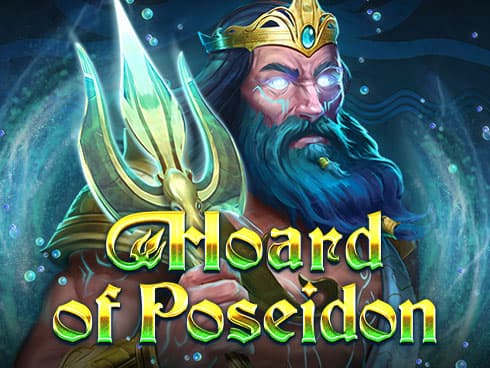
Hoard of Poseidon
Underwater-themed games from established developers are common territory in the slots industry, yet few have chosen to focus on mythology's sea ruler as the central figure.

The numbers
RTP
94.77%
Volatility
Low-Med
Max win
x3423.00
Layout
5×4
Paylines
30
Bet range
0.1 – 20
Figures as published by Red Tiger Gaming, founded 2014, Isle of Man. Operators may run a different RTP configuration — check in the game before you play.
About Hoard of Poseidon
Underwater-themed games from established developers are common territory in the slots industry, yet few have chosen to focus on mythology's sea ruler as the central figure. Red Tiger, collaborating with partner studio R7, produced Hoard of Poseidon with an explicit goal: letting players pursue the accumulated wealth of this particular deity. The promise of plundering oceanic riches drives the narrative, though in practice the actual payouts prove less generous than the mythological storyline might suggest.
Overall Presentation
While Hoard of Poseidon delivers a competent visual package, it falls short of the striking aesthetic appeal seen in Red Tiger's more recent releases. The playing field consists of five columns arranged across four rows, with winning combinations flowing across thirty fixed paths. Thematic decorations include nautical treasures, marine life imagery, and precious metals scattered throughout what appears to be the god's cavernous storage facility. The visual execution handles the job adequately without generating particular enthusiasm or displeasure. The audio component similarly occupies the background without making a meaningful impression.
Gameplay and Layout
Staking flexibility ranges from the lower end at 10 pence per coin up through 20 pounds for players inclined toward larger wagers. The base return percentage settles at 95.72 percent, positioning it slightly below industry midpoint and representing a pattern frequently observed in titles from this studio. This figure remains functional rather than problematic, though it would be welcome to see the trend reverse more often. The mathematical difficulty classification lands in medium-to-high territory, meaning that triggering various wild mechanics happens with reasonable frequency, though the more substantial winning combinations appear far less often. Even when premium features activate, players should not anticipate extraordinary financial swings.
Symbols and Core Mechanics
The paytable features a combination of basic and premium icons. Entry-level symbols consist of standard playing cards from ten through ace, supplemented by four higher-value icons representing a mollusk shell, a ship sealed within glass, an ancient tome, and an ornamental band with embedded stones. When appearing in the maximum grouping of six identical symbols across winning paths, the premium tiers deliver multipliers ranging from 2.4 times the stake up to 15 times the stake. The symbol rendering appears heavily pixelated throughout, giving them a distinctly chunky digital appearance.
Wild Feature Structure
The central mechanical feature revolves around wild substitutes rather than traditional bonus rounds or complimentary spinning phases. Four distinct wild varieties drive the entire feature set: a treasure chest, a sea creature, an ink substance, and a proportionally larger water deity icon occupying two vertical positions. All these symbols function as standard substitutes for regular pay symbols and carry the same point value as the highest premium regular icon. The interactions between these different wild types produce varying outcomes. When treasure chest and deity icons appear together, sea creatures manifest to duplicate additional chest wilds. When the sea creature and treasure chest align, tentacles secure the chest wilds to their positions for one additional rotation. A combination of deity and sea creature causes the creature to retreat, leaving trails of ink symbols in affected rows. The simultaneous presence of all three wild types, termed Poseidon's Plunder, triggers the complete cascade of effects: chest duplication, position locking, and ink wild generation across the board. Additionally, each standard spin carries the possibility of generating a multiplicative boost reaching up to 35 times the wagered amount, which enhances line wins when they occur.
Payout Potential and Long-Term Appeal
The mathematical ceiling reaches approximately 3,423 times the initial stake, though achieving this peak remains exceptionally unlikely. Full-screen matching symbols max out at 450 times the stake, requiring an extraordinarily fortunate spin where that maximum screen simultaneously combines with one of the largest available multipliers. The tension between the theoretical ceiling and practical performance creates an expectation gap. After experiencing what the Poseidon's Plunder combination produces, the novelty deflates noticeably, leaving little reason to continue engaging. The design offers intermittent entertainment through occasional favorable wild interactions, sufficient to maintain mild interest temporarily. However, no standout element provides the kind of sustained engagement that encourages extended play sessions or builds toward meaningful prize acquisition.
Final Assessment
Hoard of Poseidon represents a competently assembled release that ultimately fails to distinguish itself within an already-saturated category. The visual presentation meets minimum expectations without exceeding them. The wild interaction system provides moments of intrigue but lacks a defining feature capable of sustaining long-term player interest. Those with specialized enthusiasm for wild-heavy mechanics or underwater aesthetics might find momentary entertainment, yet stronger alternatives exist within the broader Greek mythology game segment. The title functions as serviceable entertainment during casual play sessions but offers nothing compelling enough to justify returning once novelty fades.
Hoard of Poseidon — common questions
What is the RTP of Hoard of Poseidon?
Hoard of Poseidon has a return to player of 94.77%, as published by Red Tiger Gaming. RTP is a long-run average across millions of spins, not a guide to any single session.
Is Hoard of Poseidon high volatility?
Hoard of Poseidon is a low-med volatility slot. Wins land more regularly for smaller amounts, so the balance moves more gently than on a high-volatility game.
What is the maximum win on Hoard of Poseidon?
The maximum win is x3423.00 your stake. Reaching it is rare by design — treat it as the ceiling of the maths, not an expectation.
Can I track Hoard of Poseidon in a bonus hunt?
Yes. Hoard of Poseidon is in the CasinoHub slot database, so it can be added to a hunt by name, and the tracker carries its figures into your break-even and required-multiplier maths automatically.