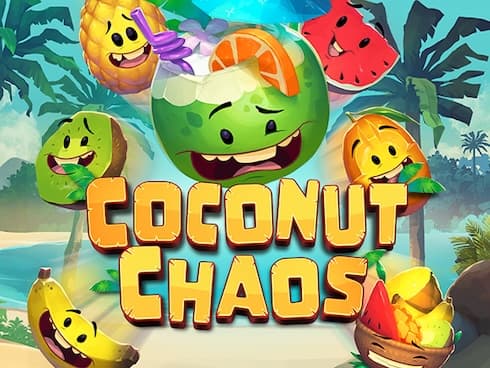
Coconut Chaos
Pineapple Play, an emerging Australian studio, has entered the slot market with Coconut Chaos, their inaugural release. Partnership with Hacksaw Gaming brings considerable industry weight, lending credibility and…

The numbers
RTP
96.36%
Volatility
Medium (3/5)
Max win
10,000x
Layout
5 reels
Paylines
14
Bet range
0.1 – 100
Other RTP configurations exist for this game: 94.27%. Casinos choose which to run.
Figures as published by Hacksaw Gaming, founded 2018, Malta. Operators may run a different RTP configuration — check in the game before you play.
About Coconut Chaos
Pineapple Play, an emerging Australian studio, has entered the slot market with Coconut Chaos, their inaugural release. Partnership with Hacksaw Gaming brings considerable industry weight, lending credibility and technical expertise from one of iGaming's most recognized publishers. For a debut, Pineapple Play needed to establish itself as a competent creator with original ideas rather than duplicating the playbook of its more seasoned collaborator. The developer has largely succeeded in charting its own path, delivering a game that blends tropical aesthetics with genuinely intriguing mechanical choices warranting attention from streamers seeking fresh content without abandoning accessibility.
The Setting and Game Mechanics
Coconut Chaos positions itself within a lush island setting, complete with beaches, palm fronds, and natural beauty rendered in bright colors. The framing emphasizes escapism and relaxation, transporting players to an imagined paradise. The game operates on a five-reel, four-row configuration using 14 fixed paylines. Players can adjust stakes from 10 cents to 100 dollars per spin, offering flexibility for both conservative and aggressive players. The design sits squarely in medium volatility, meaning payouts arrive with reasonable frequency without running toward extremes. The game incorporates no traditional wild symbols, a deliberate design choice shaping how winning lines develop.
Core Symbols and Payout Structure
The symbol collection divides between two tiers. Lower-paying symbols consist of playing card ranks from 10 through Ace, each yielding five times the wager when five appear in sequence. The upper tier features anthropomorphized fruits with distinct facial expressions—bananas, kiwi, mangos, watermelons, and pineapples. These high-paying symbols deliver substantially more generous compensation, ranging from ten times to fifty times the stake for five-symbol combinations. The hierarchy creates meaningful differentiation between standard matches and premium outcomes, rewarding players who prioritize the fruit symbols.
The Bonus Features and Gameplay Progression
Coconut Chaos activates two mechanically distinct bonus pathways with a base-game feature. The Juicer operates during regular play and within the free-spin round, converting mystery symbols into matching pay symbols. During main game sequences, hidden symbols transform into any pay symbol, including both card ranks and fruits. Once players advance into the free-spin feature, mechanics shift—only premium fruit symbols emerge from mystery reveals, since lower-paying icons have been removed. This graduated approach produces subtle intensification entering bonus territory. The free-spin trigger requires landing three, four, or five scatter symbols, granting ten, fifteen, or twenty spins respectively. Players can accumulate additional free spins by landing more scatters, with a maximum ceiling of one hundred total spins.
The secondary bonus structure introduces more originality. Pineapple Payday begins when six or more Token symbols accumulate across the reels, transitioning to hold-and-spin mechanics. Tokens become locked Coins, granting three respins initially. Respins reset each time a fresh Coin lands, and only Coins or blank positions appear on the reels moving forward. Once respins conclude or the grid fills completely, players collect a multiplier from each individual Coin—values range from one to five times the bet. These multipliers combine into a single cumulative multiplier, which applies to a final payout delivered by the Pineapple Payday reel. The crucial distinction is that Coins do not directly award cash; instead, they build the multiplier that enhances a guaranteed terminal prize. This inverts the suspense structure compared to traditional hold-and-spin games. Players focus on maximizing the total multiplier while curious about which fruit the final reel reveals. The pineapple symbol offers the highest prize value, making it the logical target for chasing the maximum win of ten thousand times the wager.
Return Rates and Feature Options
The mathematical package presents two variants. The standard configuration returns 96.36 percent of wagered money to players over extended play, a figure sitting above many contemporary releases. A secondary option reduces the return to 94.27 percent, presumably adjusting payout frequency for operators seeking different player retention characteristics. The game exhibits a hit frequency of approximately 21.87 percent, meaning winning combinations arrive more regularly than in highly volatile alternatives. Streamers should anticipate relatively frequent small outcomes punctuated by occasional substantial prizes.
Purchasing bonus rounds represents an optional engagement pathway. Players can buy direct access to the Only the Juicy free-spin feature for fifty times their current wager, or purchase immediate entry to Pineapple Payday at one hundred times the stake. These alternatives remove waiting for natural triggers, appealing to audiences preferring compressed gameplay sessions or targeted bonus exploration.
Overall Assessment
For a debut release from a studio without prior track record, Coconut Chaos demonstrates substantial competence. Pineapple Play avoided heavily borrowing Hacksaw Gaming's signature mechanics, instead cultivating its own identity through distinct thematic presentation and feature architecture. The Pineapple Payday bonus introduces a novel twist on familiar hold-and-spin concepts, transforming how multipliers operate and creating different suspense dynamics. This mechanical distinction marks a genuine contribution to the broader ecosystem.
However, the complete package contains considerable conventional elements. The base game and Only the Juicy free-spin round rely primarily on mystery symbol mechanics that, while competent, lack the distinctive character of more innovative approaches. Mystery symbols transforming into regular pay symbols represent a safe, proven method rather than bold creative expression. The transition to only high-paying symbols during free spins adds incremental appeal but doesn't fundamentally redefine the experience. Game pacing can feel measured or sluggish, particularly given non-skippable count-up animations and individual winning-line presentations that accumulate visual dead time. Without the Pineapple Payday bonus serving as a mechanical highlight, Coconut Chaos risked appearing unremarkable.
Coconut Chaos ultimately offers a serviceable first title with genuine originality scattered throughout otherwise familiar territory. The Pineapple Payday structure alone justifies examination, and the overall player experience maintains adequate engagement levels for platform exposure. The title succeeds at introducing Pineapple Play to audiences without committing major creative missteps, though it doesn't quite achieve breakthrough status. For streamer rotations focused on accessible, moderately volatile content with occasional distinctive mechanical flourishes, this release warrants inclusion within rotation schedules.
Coconut Chaos — common questions
What is the RTP of Coconut Chaos?
Coconut Chaos has a return to player of 96.36%, as published by Hacksaw Gaming. Hacksaw Gaming also ships 94.27% versions, and which one you get depends on the casino. RTP is a long-run average across millions of spins, not a guide to any single session.
Is Coconut Chaos high volatility?
Coconut Chaos is a medium (3/5) volatility slot. Wins land more regularly for smaller amounts, so the balance moves more gently than on a high-volatility game.
What is the maximum win on Coconut Chaos?
The maximum win is 10,000x your stake. Reaching it is rare by design — treat it as the ceiling of the maths, not an expectation.
Can I track Coconut Chaos in a bonus hunt?
Yes. Coconut Chaos is in the CasinoHub slot database, so it can be added to a hunt by name, and the tracker carries its figures into your break-even and required-multiplier maths automatically.